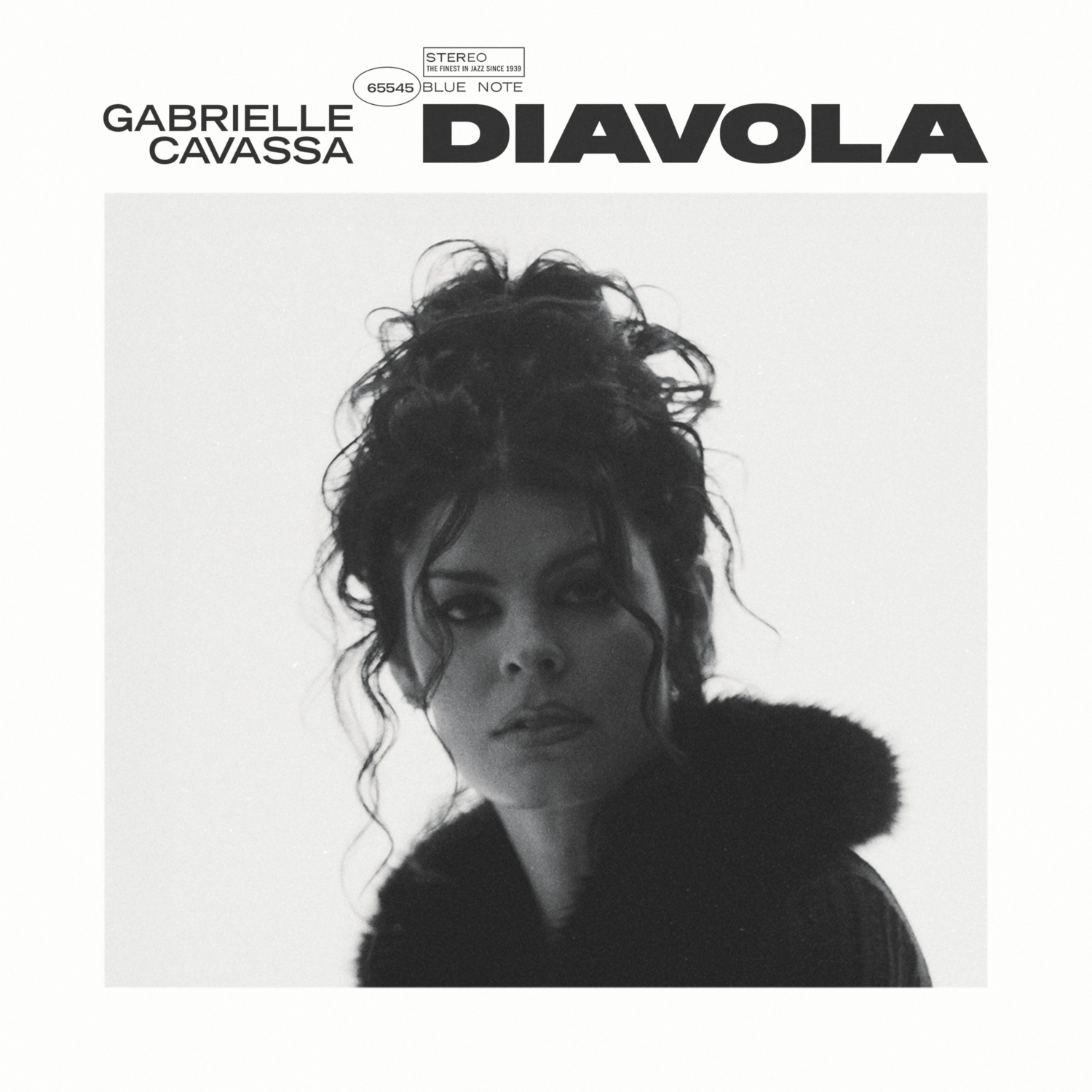
Gabrielle Cavassa – Diavola
Feat. Joshua Redman, Brian Blade, Larry Grenadier, Paul Cornish, Jeff Parker
- Heaven Sighs 0:54
(Jeff Parker)
- Raindrops Keep Falling On My Head 4:32
(Burt Bacharach/Hal David)
- Prisoner of Love 2:24
(Clarence Gaskill/Russ Columbo/Leo Robin)
- Bossy Nova 3:53
(Gabrielle Cavassa)
- To Say Goodbye 3:01
(Edu Lobo/Torquato Pereirade/Araujo Neto/Lani Hall)
- Angelo 4:21
(Luigi Tenco)
- Be My Love 3:42
(Nikolaus Brodszky/Sammy Cahn)
- Diavola 5:33
(Gabrielle Cavassa/Alexander Warshawsky)
- Could It Be Magic 6:55
(Barry Manilow/Adrienne Anderson)
- La notte dell’addio 2:27
(Giuseppe Diverio/Arrigo Amadesi/Memo Remigi/Alberto Testa)
Vocals: Gabrielle Cavassa / Piano: Paul Cornish / Guitar: Jeff Parker / Bass: Larry Grenadier
Drums: Brian Blade / Tenor Saxophone: Joshua Redman (02/09)
Produced by Joshua Redman & Don Was
Recorded by Ariel Shafir at Dreamland Recording Studios, New York
Als Saxophonist Joshua Redman 2023 sein Blue Note-Debüt „where are we“ veröffentlichte, ließ nicht nur er selbst mit dem Album aufhorchen, sondern auch die Vokalistin auf allen Tracks, Gabrielle Cavassa, die sich damit dem weltweiten Jazz-Publikum vorstellte. Das Echo war imposant, in den USA schrieb DownBeat: “Cavassa is a star in the making” und Stereophile meinte: “For many, the revelation of this album will be Cavassa”. Auch hierzulande waren die Reaktionen ähnlich: „Top-Sängerin“ (Stereoplay, Werner Stiefele), “Redman und Cavassa ergänzen sich kongenial und bringen die Luft im Studio zum Flirren“ (Süddeutsche Zeitung, Andrian Kreye). Bei der darauffolgenden Welttournee des Joshua Redman Quartet begeisterte die Sängerin erneut das Publikum.
Mit ihrem hypnotischen Debütalbum „Diavola“ feiert Gabrielle Cavassa jetzt ihren künstlerischen Durchbruch und Einstand als Blue-Note-Künstlerin. Das Album offenbart ihr Können als Sängerin, Bandleaderin und Songwriterin, sie erweist sich als furchtlose und emotionale Interpretin von Songs, die ein weites Spektrum vom Jazz-Standard („Prisoner of Love“) über klassischen Pop („Raindrops Keep Falling On My Head“ von Burt Bacharach und „Could It Be Magic“ von Barry Manilow) und italienische Evergreens („Angelo“) bis hin zu brasilianischen Songs („To Say Goodbye“ von Edu Lobo) abdecken. Interpretiert mit Feingefühl von einer Jazz-Künstlerin deren Motto lautet: „Ich habe größten Respekt vor Liedern und möchte sie bestmöglich würdigen“, klingen diese unterschiedlichen Werke wie aus einem Gruß. Obwohl Cavassa die Songs neu ausdeutet, mit den Melodiebögen spielt und nicht selten die Tempi dehnt und entschleunigt, bleiben Seele und Aussage der Songs intakt. „Diavola“ wurde koproduziert von Joshua Redman und Don Was und überzeugt neben den originellen Songs auch durch brillante Arrangements und exquisite Musiker: Jeff Parker an der Gitarre, Paul Cornish am Klavier, Larry Grenadier am Bass, Brian Blade am Schlagzeug und Produzent Joshua Redman an zwei Titeln am Tenorsaxofon.
Die in Escondido, Kalifornien, geborene Gabrielle Cavassa, deren Vorfahren aus Italien stammen, begann schon früh, intensiv Musik zu hören. Weitgehend autodidaktisch entwickelte sie einen einzigartigen Gesangsstil, der später ihr künstlerisches Schaffen prägen sollte. Cavassa schloss ihr Musikstudium an der San Francisco State University mit einem Bachelor of Arts ab, verdankt ihre eigentliche musikalische Ausbildung jedoch der Musikszene der Bay Area. 2017 zog sie nach New Orleans und veröffentlichte 2020 in Eigenregie ihr Debütalbum „Gabrielle Cavassa“, produziert von ihrem musikalischen Partner Jamison Ross. 2021 gewann sie die renommierte International Sarah Vaughan Jazz Vocal Competition.
INFO
“I really respect songs and I really want to honor them in the best way,” says vocalist Gabrielle Cavassa. With her riveting Blue Note debut Diavola, Cavassa makes her artistic arrival with an album that unveils her range as a band leader, a songwriter, and a fearless song interpreter who treats each gesture with subtlety and reverence. The California-born, New Orleans-based artist presents a collection of original songs and luminous arrangements alongside collaborators Joshua Redman, Jeff Parker, Paul Cornish, Larry Grenadier, and Brian Blade.
Co-produced by Redman and Don Was, Diavola subverts the self-portrait. The album explores coexistences of the angel and the devil — a dynamic central to Cavassa’s artistry and personal identity — engaging a dualism of possession and surrender, of urgency and repose. “I’m not willing to let go of either,” says Cavassa, “or I haven’t been able to.”
At once intimate and anthemic, Diavola spotlights Cavassa’s pivotal association with Redman, who invited her into the studio and on the road as a collaborator for his own Blue Note debut where are we, released in 2023. “It’s kind of a Cinderella Story,” says Cavassa, who began working with Redman after his manager heard her perform at a wedding in New Orleans. “That was such a shocking life change,” she says. “It was such a rare opportunity as a singer to be able to tour on that level as a sideman. And in jazz, it’s a rite of passage.”
Was and Redman worked in concert with Cavassa from the album’s inception. While Redman focused on production details, Was worked listener impact. Together, the artists set the pace for each section as Cavassa’s interpretations developed their tones and colors. “Josh was with me every step of the way,” she says. “He was the comfort and the trust through the whole process. And Don was bringing this wisdom of absolutely one-in-a-million experience.”
Diavola opens on “Heaven Sighs,” a sunrising resonance from Parker that leads into a sublime rendition of Burt Bacharach’s “Raindrops Keep Falling On My Head.” Arpeggiating chords create space for Cavassa’s intimate vocal, but the tempo’s relaxed bounce took time to perfect. When Was told them it needed to be faster, Blade generated a groove as buoyant as it is mysterious and unhurried. “He’s a giant,” says Cavassa.
Admittedly a “huge” Billy Eckstine fan, Cavassa swings slow and steady on “Prisoner of Love.” Each lyric she charms with deliberate long tones and thoughtful dynamics. “I make sure I’m forward-facing, and modernity is important to me,” says Cavassa, “but the truth is I really am coming from a tradition. And I really love singing those songs.”
Intent on transporting listeners to the late 1950s Amalfi Coast, “Bossy Nova” delivers a potent message beneath its shimmering Brazilian syncopation. Featuring Cavassa on rhythm guitar and a dreamy solo from Parker, the song tumbled out of her consciousness and onto her kitchen table in a matter of minutes. “It’s one of those that just fell out,” she says. “I guess it’s a comment on sacrifice, and what I’m sacrificing for, which is this beautiful dream.”
In recent years, Cavassa has nurtured an extraordinary ability to inhabit not just the lyric but the full story of the song. That humanness animates Diavola. “To Say Goodbye” serves as a turning point on the record. Parker and Cavassa begin in deceptive rubato. And a doleful solo from Grenadier at once restrains and absorbs the anguish of the album’s first minor tune. Cavassa sought a pivot from the dreamy tunes to the tumultuous ones in the way she sequenced the album. “This one felt right for the record in its mood,” she says.
Luigi Tenco’s “Angelo” and Cavassa’s “Diavola” serve as inverses of each other — and the beating heart of the entire album. On the former, Grenadier’s lamenting arco empathizes with Cavassa’s despairing vocal, delivered in its original Italian; on the latter, his stalking bass line over an extended drone foreshadows a fall from grace. “Diavola” captures Cavassa’s own turmoil in her honest, lamenting vocal.
“In ‘Angelo,’ this character is coming from a really dark place and almost coming to the light,” she says. “Who knows — maybe it’s just a manipulator in the cycle of abuse. But I absolutely love its honesty.” At the other end, “‘Diavola’ is coming from an angelic place, being in a relationship and trying to appease the other person. It’s really feeling like too much and she breaks, and devolves into Diavola. ‘Angelo’ and ‘Diavola’ are a pair because they sort of turn into each other. There are cracks in each of them where a piece of the other can be seen.” Presenting the character Diavola as a flawed archetype as opposed to a true villain creates real tension on the record. “The whole album reflects Diavola,” says Cavassa. “She is a character but also an idea that holds these two opposing parts.”
Between them, “Be My Love” becomes the album’s pinnacle. Its gauzy drone lays bare Cavassa’s vulnerability and warmth. “It’s not a drama, it’s a meditation. It’s so patient. It’s really like a breath in or a breath out — maybe both.” Cornish sweeps up the listener in a lucid dream ballet on Barry Manilow’s “Could it Be Magic.” Cavassa reframes the sentimental love ballad with understatement, while Redman delivers a signature solo through an exultant modulation.
A kind of epilogue, the album closer “La notte dell’addio,” is an exhale, if not a resolution. Cavassa and Cornish transmit mutual tenderness. “It was the last thing we recorded,” says Cavassa, who insists light is not a remedy for dark and there is nothing to vanquish: “This is a gentle mourning. It’s a gentle kind of hope and acknowledgment of grief or what we’ve been through.”
Weitere Infos in unserem Presseportal unter
https://journalistenlounge.de – bitte dort über den Genrefilter „Jazz“ anwählen!
PR Radio
Universal Music Jazz (Deutsche Grammophon GmbH)
Mühlenstr. 25, 10243 Berlin
Blue Note / Universal Music
CD 00602478065538 / LP 00602478065545
VÖ: 01.05.2026
Alle Informationen unter Embargo bis 11.02.2026