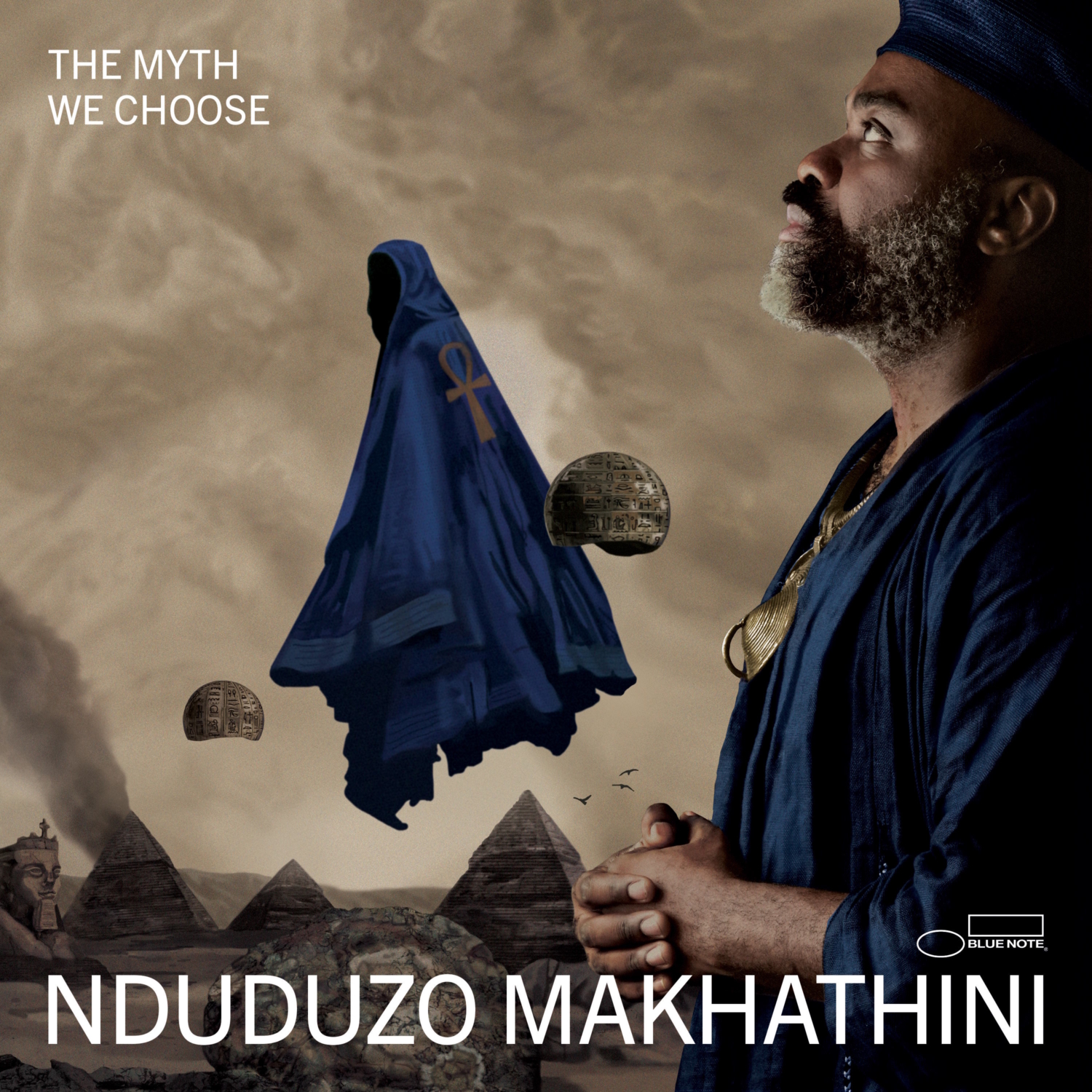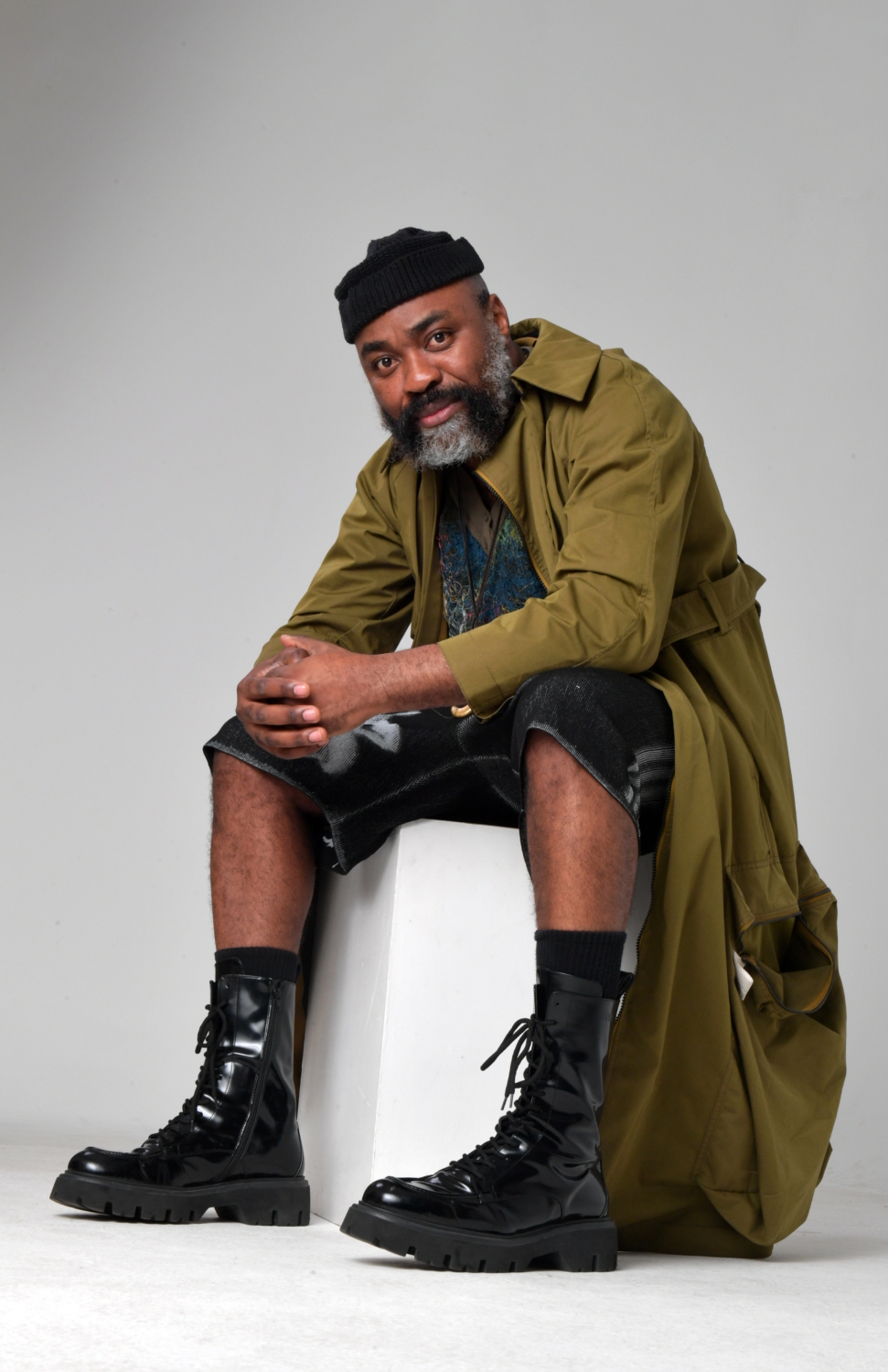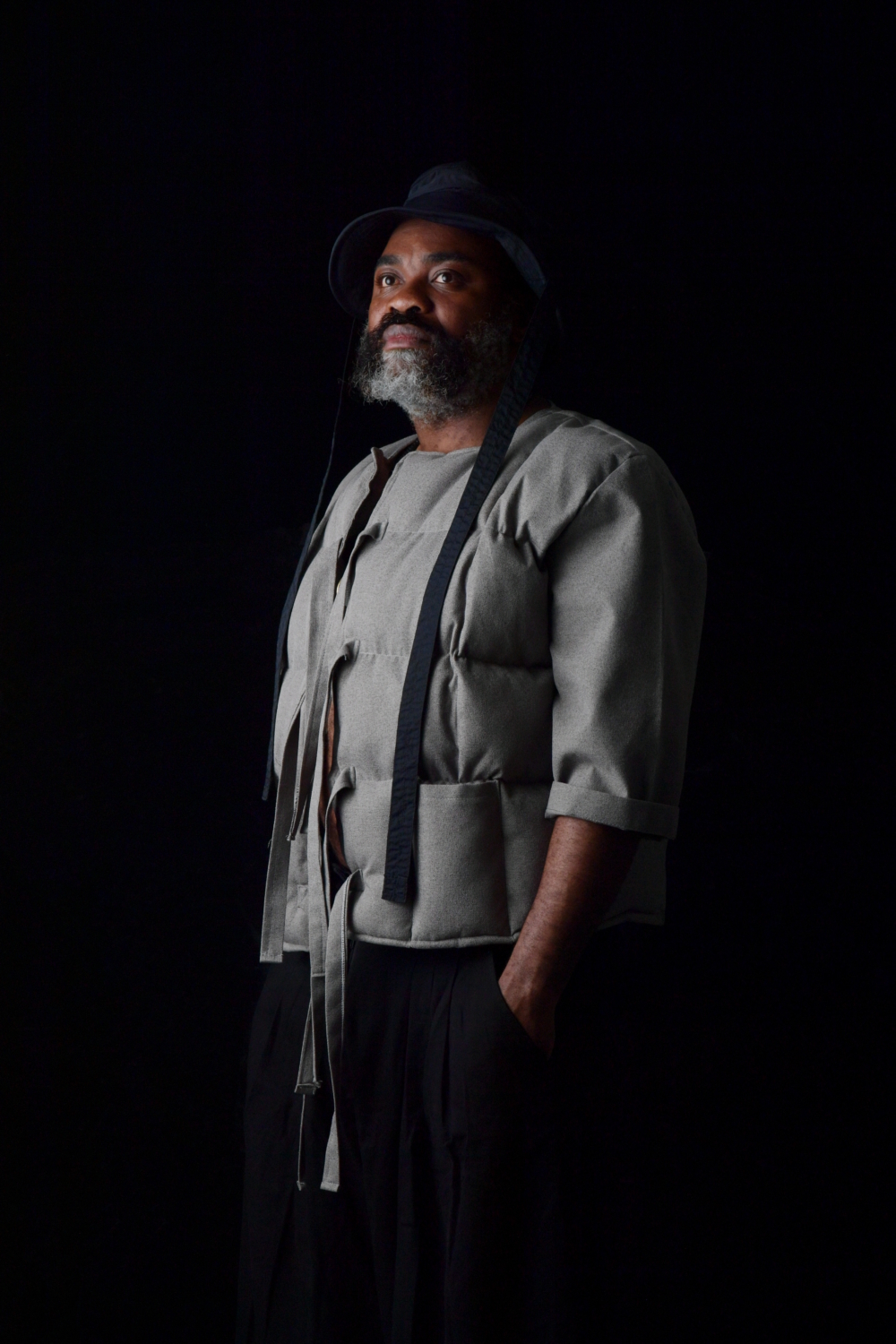
Nduduzo Makhathini – The Myth We Choose
- Kuzodlula 4:44
- Imvunge KaNtu 3:02
- Kwamabili 3:11
- Unembeza 4:25
- Liyoze Line Nangakithi 4:27
- What People Say 3:06
- Primordial Egg 2:32
- Ekuqaleni 2:17
- Ḽiṅwalo ḽa Mubebi 6:23
- Umbono 5:03
- Ḽiṅwalo ḽa Mubebi (reprise) 2:41
- Tethered 5:38
- Ongaphesheya 2:49
- What People Say (reprise) 6:25
- Kuzodlula (reprise) 2:27
- Zimthilili 5:09
Composed and arranged by Nduduzo Makhathini / Thingo Makhathini, Nduduzo Makhathini and Muneyi (9, 11) / Nduduzo Makhathini and Thando Zide (12) / Nduduzo Makhathini, Black Coffee and Omagugu (14)
Nduduzo Makhathini: Piano, keyboards, vocals, vocoder and additional programming / Dalisu Ndlazi: Double bass / Lukmil Perez: Drums / Ayanda Sikade: Drums (7, 16) / Black Coffee: Drum programming (14) / Robin Fassie: Trumpet (1) / Keenan Ahrends: Guitar (10) / Shabaka: Flute (5) / Omagugu: Vocals (6, 14) / Muneyi: Vocals (9, 11) / Thando Zide: Vocals (12)
Produced by Nduduzo Makhathini / Co-produced by Thingo Makhathini
Recorded by Peter Auret at Sumo Sound Studios in Johannesburg, South Africa
Mit seinem beeindruckenden vierten Blue-Note-Album “The Myth We Choose“ erkundet der südafrikanische Pianist, Komponist, Heiler und Philosoph Nduduzo Makhathini, wie verschiedene Gesellschaften ihre Mythen durch Lieder erschaffen. Das Album, das von seinem Sohn Thingo Makhathini mitproduziert wurde, präsentiert Makhathinis unverwechselbaren Klang in einem breiten Spektrum von Arrangements. Mit dabei sind Bassist Dalisu Ndlazi, Schlagzeuger Lukmil Perez sowie Gastmusiker wie Black Coffee, Shabaka, Omagugu, Thando Zide und Muneyi.
LIVE
- Mai 2026 – Moers – Nduduzo Makhathini & WDR Big Band – Moers Festival
INFO
Most musicians, even brilliant jazz improvisers, prioritize the present when recording and releasing new work. What kind of reviews is this record going to get? Will my fans like it? Is it going to sell?
But with his stirring new Blue Note album, The Myth We Choose, the pianist and composer Nduduzo Makhathini is focusing on the impact his music will make throughout the arc of time. Co-produced by Makhathini and his 18-year-old son, Thingo Makhathini, The Myth We Choose features riveting performances by the pianist’s working trio with bassist Dalisu Ndlazi and drummer Lukmil Perez (or, on select tracks, Ayanda Sikade), plus special guests including Shabaka Hutchings and a stacked lineup of South African talent: DJ and producer Black Coffee, trumpeter Robin Fassie, guitarist Keenan Ahrends, and the vocalists Thando Zide, Muneyi and Omagugu, Makhathini’s spouse and longtime collaborator. This is music made for posterity — even eternity.
Songs are vital to a culture’s myth-making, Makhathini argues, which makes them essential to how future generations perceive history. “I have always felt that songs speak to us, songs look at us,” he writes in the album’s liner notes. “In years to come, it will be the histories of the day that will choose or not choose our songs. If our songs are not chosen, then our voices would never be heard… On the contrary, if our songs are chosen, then indeed, what we are dealing with now is designing future myths. With our actions today, we are making suggestions for what tomorrow may be.”
That’s a profound ambition for an LP, but coming from Makhathini, it’s hardly surprising. To the 43-year-old South African — an educator and healer as well as a venerated musician — a performance is a ritual that demands real engagement from its audience and does an incredible amount of conceptual heavy lifting. Music invokes personal, familial and cultural stories, Makhathini says. Music is prophecy. Music can restore physical vitality.
To say it another way, he doesn’t make music to merely entertain — even as his music proves positively thrilling. As he’s demonstrated throughout an extensive discography, including three previous albums for Blue Note, Makhathini merges spirit-seeking American jazz — in particular, the music of his heroes John Coltrane and McCoy Tyner — with the most irresistible traits of South African jazz and the galvanizing rhythms of Afro-Cuban music. Like Trane and Tyner on A Love Supreme, he’s forever pushing and ascending; at the same time, his touch and language on the piano are imbued with the earthy, gospel-tinged melodic radiance of Abdullah Ibrahim or his greatest mentor, Bheki Mseleku.
In truth, words cannot begin to encapsulate his aesthetic, which is ever-evolving. And on The Myth We Choose, Makhathini’s soundworld expands further still, thanks in large part to Thingo, who helped his father steer the album (though he doesn’t perform on it). A producer, songwriter and multi-instrumentalist who focuses on the alto saxophone, Thingo has developed a deep and wide-ranging understanding of music old and strikingly new, which proves transformative throughout The Myth We Choose. “Every time you hear a connection to electronics, or different kinds of grooves that people don’t as often associate with me, those are his ideas,” says Makhathini.
An exceedingly modest man, Makhathini has delivered all sorts of grooves throughout his career, and is no stranger to collaborations with artists at the vanguard of contemporary music. But on The Myth We Choose, these sounds are more fully realized, and more thoroughly subsumed into Makhathini’s artistry. The result is an album that enhances the accessibility of Makhathini’s music without sacrificing any of its spiritual integrity. Take “Tethered,” for instance, “about the inevitability of love against the inability to gauge our emotional entanglement when one is deep in love,” says Makhathini. Imbued with artful neo-soul and featuring the singer Thando Zide, it comes across as both sultry and sacred, an enigmatic convergence of body and spirit. The closing “Zimthilili,” with sweetly hypnotic vocals from the pianist, is equally magnetic.
Or cue “Ḽiṅwalo ḽa Mubebi,” co-composed by Makhathini, Thingo and the guitarist and vocalist Muneyi. A tribute to fatherly love — and to fathers who transcend the masculine stereotypes that prevent them from professing that love — it digs into an elusive space between a torchy, brushes-fueled vocal-jazz ballad and a heartrending pop piece. The English-language ballad “What People Say” is another affecting gem, a meditation on the creation of myths featuring Omagugu. Both tracks are unforgettable, dripping with feeling and demanding repeat listens. Ditto “Ekuqaleni,” where Makhathini matches the high drama and constant motion of The Bad Plus with Kraftwerkian vocoder.
Vocals, including Makhathini’s incantations, take pride of place at various points, and the decision to color more songs with voice was rooted in part in our fractured, dystopian global landscape. Singing, Makhathini explains, can be a more lucid, urgent delivery system for his message about music’s hallowed communal role. “I think, in a world that’s a minute from falling apart,” he says, “there’s a need to utilize human language more, to be very intentional about what we mean.”
The same argument could be made for the use of electronics on the album — both Makhathini’s own keyboards and programming as well as the drum programming that Black Coffee contributes to “What People Say (reprise).” “Jazz has always been a result of socialization,” Makhathini says, “and of deep listening to society and the sounds that are happening around us.” He points to Miles Davis as a prime example of someone who found creative strength by embracing the innovations of popular music.
Of course, the album’s overwhelming spirit of transcendence is rooted in hard-won mastery and the joys of human collaboration. “Kuzodlula” contemplates the nature of forgiveness — “real forgiveness is the very attempt to forgive the unforgivable,” says Makhathini — with virtuosic trumpet filigree from Fassie, a protégé. With its hard-angled grooves, handclaps, avant-garde coloring and spoken/sung invocations, “Imvunge KaNtu” is a bold tribute to ancient African wisdom and the concept of interconnectedness known as Ntu. Conversely, “Unembeza” is a slow-to-mid-tempo delight, an exercise in the gospel-kissed glow that is uniquely South African. (In an interesting juxtaposition, its thematic inspiration is the question of how our world will end.)
A kind of hymn to the blessings that accompany rain, “Liyoze Line Nangakithi” is a gently probing conversation between Makhathini, his longtime friend and collaborator Shabaka, on flute, and Dalisu Ndlazi on double bass. “Dali is someone I’ve mentored for years, and I’ve been playing with him since he was really young,” says the pianist. “Shabaka and I share a lot of music. We share ideas about being in the world, and about cosmology.”
Ultimately, The Myth We Choose is about the awareness to create a legacy of love and healing in the present tense. “This notion of a Black body as being animated and used for entertainment has failed historically,” says Makhathini. “So, for me, accepting the failure of Black performance, I resort to this idea of ritual” — the idea of past, present and future all commingling on the same plane. What’s more, in this ritual the composer, performers and audience become equal partners, facing the sounds that inspire self-reflection with open hearts.
“Wayne Shorter said something really beautiful that I liked some years ago,” Makhathini continues. “His idea was to play and write music the way you want the world to be, the world that you hope for. That’s always my purpose.”
LINER NOTES
– It was on 09 May 2019 when Nduduzo Makhathini appeared on the bandstand at a Hard Rock Cafe in Johannesburg with his quartet for the evening. However, there was another conspicuous member of the band, represented by a dark oak chair placed in front of the band, as if the chair were a lead vocalist/frontline horn player in a standard jazz configuration on the bandstand.
– As the crowd appeared to be distracting Makhathini, he wasted no time in reprimanding the unruly crowd. He went on to introduce the wooden chair as iKhehla/Umkhulu (elder ancestral spirit) who was a collective representation of accompanying spirits of abalozi (typically represented by ornithological creatures that always prefer silence) and a frequency that could be accentuated through silence as “I believe there is more music in silence than in sound itself so we would like to move from silence so that we can have one frequency that is accompanied by the kinds of spirits that are on the band stand now and if you do not open your eyes why you have to see them, at least feel them. There is something important that we are doing here. Ungagangeli kulomsebenzi esiwenzayo! (Do not take our work for granted!).”
– The message that has always been omnipresent through the sounds of Makhathini has always been one of healing, primarily through amathambo (as represented by piano keys), sound, and silence. On the latest offering there is a lingering spirit of Keith Jarrett’s 1989 album Changeless that is enhanced by a more vocal slant that invokes the spirits of Johnny Dyani, Bheki Mseleku, and Zim Ngqawana, whilst also expanding the ever-evolving Makhathini songbook with more vocal pieces, courtesy of Gundu co-founder and singer Omagugu, as well as Muneyi and Thando Zide.
– The myth we choose could take the form of a firm belief that there is indeed more music in silence than in sound itself.
Mbongeni Floyd Muhal Mathibela
Cape Town, 27 December 2025 = 27/12/2025 = 3 = represents completeness
CODA – 11/01/2026 – Sunday 11 January 2026
Spirit numbers were a part of life in the ancient times (Old Time) of the Black People of Africa and any other people on earth, who referred to themselves as Bantu or Abantu, which is plural for Umuntu. The prefix ‘Mu’ denotes the agent (‘Ba’ being the plural). The great Zulu shaman, Vusamazulu Credo Mutwa, describes in his 1964 book “Indaba, My Children” that Ntu is a contraction of the word ntu-tu-tu, an onomatopoeic term for the steps of a creature walking on 2 legs instead of 4. Thus, the word muntu means more than just a ‘human being’ or ‘man’. It means ‘he who walks erect’, or to denote the agent, the ‘two-legger’.
An Ongoing Rehearsal in Ntu Sonicities (Makhathini’s upcoming book title) lends itself to a discourse about the inability to escape our own being in the moment of making the music and the sound while being cognisant of the notion that a myth is a part of history/time that we select such that the natural conclusion is that there ought to be an effort towards rehearsing the myth on an ongoing basis, which can assist in reversing the problem of forgetting certain African histories. Pianist Vijay Iyer has previously addressed the idea of historicity through his 2009 jazz trio album, in which he asked whether some theoreticians characterise historicity as a dimension of all natural phenomena that occur in space and time.
The meditations/numbers presented on this latest chapter of Ntu Sonicities {body ofwork} are numbered from one to sixteen. The order of the numbering is asintentional as the creator (One). Sixteen (16) can be broken down using its digits as 1 + 6 = One + Six = 7. One is regarded as the holiest of all numbers as it representsthe combining of all created things – the Oneness or the Whole, which is God. It isan absolute number and has no rival. It is also the symbol of freedom.
6, on the other hand, is what is referred to as the first perfect number. A perfect number can be expressed as both the sum and product of all its factors.
For example, factors of 6 are 1, 2 and 3. The sum is 1 + 2 + 3 = 6 and the product is 1 x 2 x 3 = 6. 6 (isithupha) also represents strength and it symbolizes the six component parts that constitute the human being: the soul, the Ena, the body, the mind, the Living Force, and the Adverse Force. The Living Force or Life, is the Spirit of God, and is constantly opposed by the Spirit of Evil; the one generates Life, the other promotes Death.
Half of 16 is 8, which is a track titled ‘Ekuqaleni’. 8 is associated with infinity/infinitude. At the same time, some myths believe the number 8 is associated with genetic weaknesses, frigidity, war, and death in a vile form. However, the title of the 8th number itself refers to the number 1, as it loosely translates to ‘in the beginning’ = 2026 = 2 + 0 + 2 + 6 = 10 = 1 + 0 = 1 which is where we are now, with an intentional view to saying something to the future right now, while at the same time designing future myths.
ARTIST NOTES
For a period now, I have been contemplating on what constitutes a myth. A lot of my previous works have had an interest in creation stories: how things came about and the place of sound in those moments of creation. As such, my work has had a strong leaning on what I have termed ‘ntu cosmology’, as a central point of departure for thinking/doing/sounding. For this current work I am thinking of a much more relational approach that looks into how various societies choose their own myths and some of what seems to be the common characteristics of myth-making.
I strongly believe that songs have a huge contribution in myth-making. Songs have a way of influencing public discourse. In this manner, songs can be understood as forms of texts that produce specific meanings. I have always felt that songs speak to us, songs look at us. In years to come, it will be the histories of the day that will choose or not choose our songs. If our songs are not chosen, then our voices would never be heard, and the ones to be born would wonder who we were. On the contrary, if our songs are chosen, then indeed, what we are dealing with now is designing future myths. With our actions today, we are making suggestions for what tomorrow may be. Such a state puts an implication on what we choose to say, do or even play in this moment.
I want to play that which I mean. I perceive that which I share in this work as a type of text, or even a kind of speech. I am saying something to the future. I am taking an oath; I am attempting truth.
Nduduzo Makhathini
ANECDOTES
‘Kuzodlula’ is about the difficulty of forgiveness and that real forgiveness is the very attempt to forgive the unforgivable. To forgive is to transcend rational thought, it is to have an encounter with the spirit of things.
‘Imvunge’ is an invocation of the spirit deities of Ntu. This piece also pays tribute to the Zulu kingdom, its lineage and its origins above (emazulwini) and below (ngaphansi komhlaba).
‘Kwamabili’ speaks to the sacred hours of the star gods and our ability to connect with spirit worlds while deep in our sleep (emathongweni). This piece is a dedication to the great Zulu Shaman Credo Muthwa.
‘Unembeza’ is a song about that age-old question of the end of the world. “How will the world end?” The piece posits that the world will not end when buildings collapse or when everything burns down. Instead, the world will end when humans stop sensing and lose their conscience. Thus, the end of the world will be marked by the fall of ethics, morality and Ntu principles.
‘Liyoze Line Nangakithi’ speaks of the intimacy between the rain and the soil but also that of the earth and the heavens (Ma’at). In Nguni mythology it is understood that the rain comes as a result (or a symbol) of blessings. As such, Nguni people always pray for the rain as a way of appeasing uNomkhubulwane, and invoking abundance.
‘What People Say’ is about how myths are created, and how particular histories and societal discourses within epochs have a way of choosing myths. The piece goes on to suggest how feeling and sensing creates a border between that which is real and that which belongs to mythical institution.
‘Primordial Egg’ indexes the beginning of things and an egg as symbol of potential to all that was eventually realised as life on Earth. It also symbolises the vulnerabilities that come with experiencing life outside the egg (seen as a safe space).
‘Ekuqaleni’ is an invocation of essence. It is based of the creation myth of the Zulu people and their belief that they broke off the reeds (“sadabuka ohlangeni”). This suggests that there was a pre-existent essence where all life locate origin.
‘Ḽiṅwalo ḽa Mubebi’ is a father’s love letter to his child, an affirmation of a child’s birth, ordained and recognised by the ancestors. A father’s love that would lay itself down for the son. A father’s love letter that affirms his presence, his love and his protection. This piece speaks specifically against masculine stereotypes that suffocate language for fathers to express love to their boy children.
‘Umbono’ is about the ability to see beyond form and material. It is an invitation to think much deeper about what people may refer to as a vision, often as an abstract concept. This piece perceives visions as realities taking place elsewhere and the ability to see spiritual things as a sense that all humans once possessed but it got lost.
‘Tethered’ is about the inevitability of love against the inability to gage our emotional entanglement when one is deep in love. The piece speaks about how life does not wait for one to grasp the fullness of what it means to fall in love.
‘Ongaphesheya’ speaks to the language of the spirit. There is always a kind of exile that is experienced when one steps outside of the body-spirit wholeness.
‘Zimthilili’ is a love song ‘overtime’. The song connects a childhood story of a love letter written privately but, unfortunately, was read in a school bus filled with pupils. Then it pushes forward from the story of embarrassment to finding a soulmate. Essentially it looks at these moments as a kind of rehearsal that love, sometimes, requires.
Weitere Infos in unserem Presseportal unter
https://journalistenlounge.de – bitte dort über den Genrefilter „Jazz“ anwählen!
PR Radio
Universal Music Jazz (Deutsche Grammophon GmbH)
Blue Note Records / Universal Music
2-LP 00199957431088
CD 00199957431071
VÖ: 26.06.2026
Live
Nduduzo Makhathini + WDR Big Band
21.05.26 Moers, Moers Festival